 Home / News / Industry News / Comparing Epoxy, Polyurethane, and Acrylic Automotive Body Adhesives
 2026-02-26
Automotive manufacturing and repair have come a long way in the past few decades. Modern vehicles are not just assemblies of metal panels held together with mechanical fasteners; they rely heavily on automotive body adhesives to enhance structural integrity, reduce weight, and improve safety. Among the wide range of adhesives available in the automotive industry, epoxy, polyurethane (PU), and acrylic adhesives are the most commonly used for bonding body panels and structural components. Each type has unique chemical properties, application methods, and performance characteristics, making them suitable for different automotive applications. In this article, we will compare epoxy, polyurethane, and acrylic automotive body adhesives to help engineers, repair technicians, and manufacturers make informed choices.
Automotive body adhesives are specialized chemical compounds designed to join two surfaces, such as metal, plastic, or composites, without the need for mechanical fasteners like screws, bolts, or rivets. Unlike traditional welding or riveting, adhesives distribute stress over a larger area, reducing localized stress points and improving the overall durability of a vehicle’s structure.
The primary functions of automotive body adhesives include:
Structural bonding – Reinforcing vehicle frames, pillars, and body panels.
Sealing – Preventing water, dust, and air infiltration.
Noise, Vibration, and Harshness (NVH) reduction – Acting as dampers to minimize vibrations and noise.
Corrosion resistance – Providing a protective layer between dissimilar metals.
Choosing the right adhesive depends on multiple factors, including substrate type, environmental conditions, curing time, and desired strength. The three most widely used types—epoxy, polyurethane, and acrylic adhesives—offer distinct advantages and limitations.
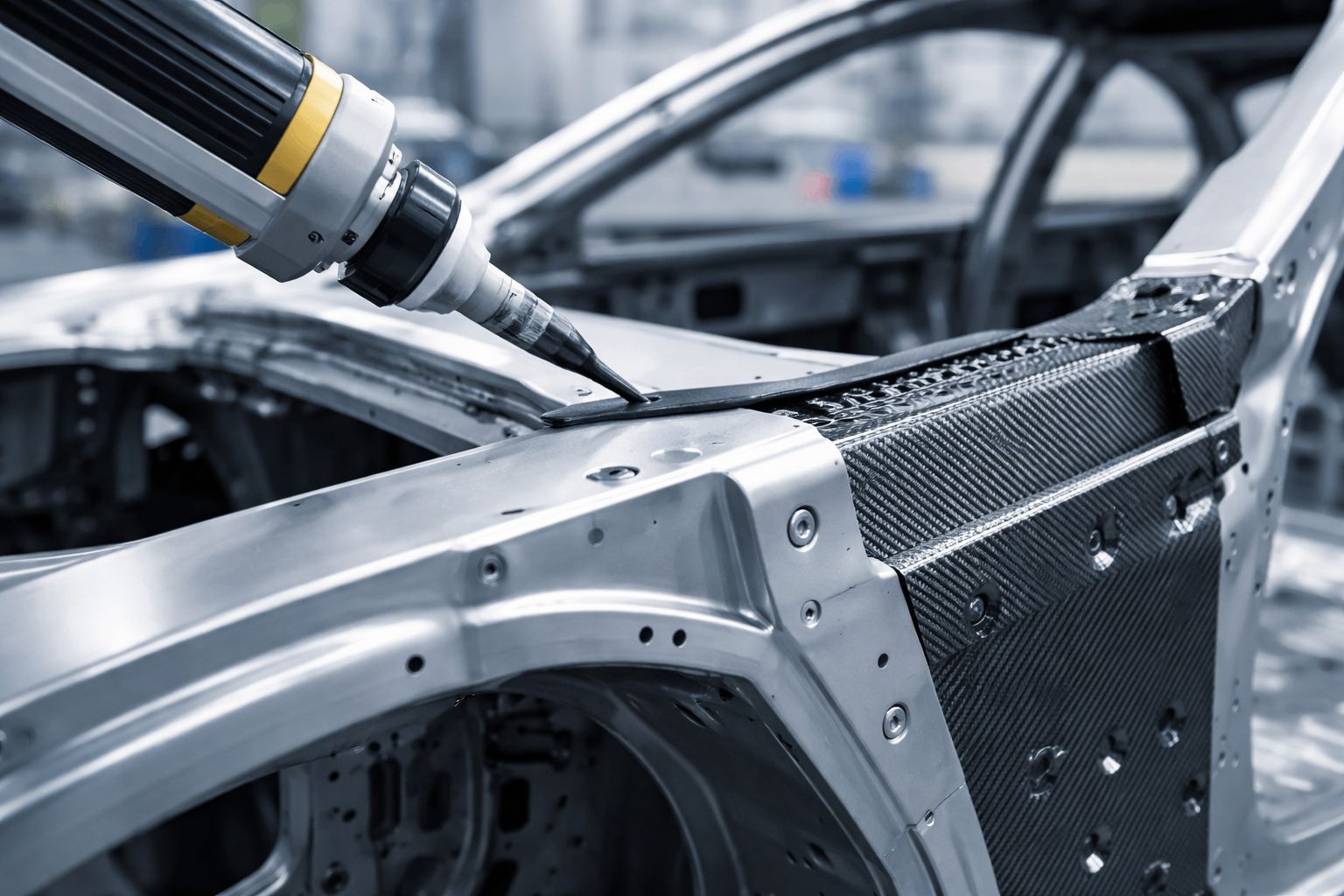
Epoxy adhesives are thermosetting polymers formed by the reaction of an epoxide resin with a curing agent. They are known for their superior strength, chemical resistance, and durability, making them ideal for structural applications in the automotive industry.
High strength: Epoxies provide excellent tensile and shear strength, allowing them to bond metals, composites, and even some plastics effectively.
Chemical resistance: Resistant to oils, fuels, solvents, and most automotive fluids.
Temperature tolerance: Can endure moderate to high temperatures, depending on the formulation.
Long cure time: Epoxies typically require hours to fully cure, which can slow production if rapid assembly is needed.
Structural bonding of chassis components
Reinforcing suspension mounts and subframes
Bonding composite materials, such as carbon fiber panels
Adhesive metal repair in collision repair shops
Excellent strength and durability.
Superior resistance to chemicals and corrosion.
Can bond a wide range of materials.
Longer cure times can reduce production efficiency.
Limited flexibility; not ideal for applications requiring movement or vibration absorption.
Surface preparation is critical for achieving maximum bond strength.
Polyurethane adhesives are versatile, one-component or two-component systems that cure through a reaction with moisture or a chemical hardener. PU adhesives are widely used in automotive applications due to their flexibility, impact resistance, and ability to bond different substrates.
Flexibility: PU adhesives remain elastic after curing, allowing them to absorb vibration and impact energy.
Good adhesion: Bond metals, plastics, composites, and painted surfaces.
Moisture resistance: One-component PUs cure in the presence of atmospheric moisture, making them ideal for on-site assembly.
Moderate temperature resistance: Generally effective in temperatures ranging from -40°C to 90°C, though high-temperature formulations exist.
Sealing windshields and glass panels
Bonding bumper covers, side panels, and roof assemblies
Noise and vibration damping applications
Adhesive structural reinforcement of lightweight aluminum or magnesium components
High elasticity and impact resistance.
Bonds well to a variety of substrates.
Suitable for both manufacturing and repair environments.
Lower ultimate strength compared to epoxy adhesives.
Sensitive to UV exposure if not protected.
Moisture-curing formulations require controlled environmental conditions to achieve consistent results.
Acrylic adhesives are another popular choice in the automotive industry, especially for bonding dissimilar materials and achieving fast assembly times. These adhesives cure via a polymerization reaction, often accelerated by heat or UV light.
Fast curing: Acrylics can achieve handling strength within minutes and full strength in hours.
Good adhesion to diverse substrates: Effective on metals, plastics, composites, and painted surfaces.
Moderate flexibility: Less rigid than epoxy but not as elastic as polyurethane.
Temperature and weather resistance: Acrylics withstand UV exposure, temperature fluctuations, and moisture reasonably well.
Bonding exterior body panels
Joining mixed materials such as aluminum-to-plastic or steel-to-composite
Rapid assembly in high-volume production lines
Glass and trim installation
Rapid curing accelerates production processes.
Strong adhesion to both similar and dissimilar materials.
Reasonable resistance to weathering and UV light.
Less chemically resistant than epoxy adhesives.
Limited elasticity compared to polyurethane adhesives.
Surface preparation is important for optimal bonding.
| Feature | Epoxy Adhesives | Polyurethane Adhesives | Acrylic Adhesives |
|---|---|---|---|
| Cure Time | Long (hours to days) | Moderate (minutes to hours) | Fast (minutes) |
| Strength | Very High | Moderate | High |
| Flexibility | Low | High | Moderate |
| Chemical Resistance | Excellent | Moderate | Moderate |
| Temperature Resistance | High | Moderate | Moderate |
| Bonding Range | Metals, composites, some plastics | Metals, plastics, composites | Metals, plastics, composites |
| UV/Weather Resistance | Moderate | Moderate | High |
| Best Applications | Structural, high-strength bonding | Impact absorption, vibration damping | Fast assembly, mixed-material bonding |
Selecting the ideal automotive body adhesive depends on several critical factors:
Substrate Type:
Metals like steel and aluminum bond well with epoxy and acrylic adhesives.
Plastics and composites often require polyurethane or acrylic adhesives.
Structural Requirements:
High-strength, load-bearing components benefit from epoxy adhesives.
Flexible joints or components exposed to vibration favor polyurethane adhesives.
Production Speed:
For high-volume assembly lines, acrylic adhesives provide fast curing.
Epoxies are better suited for repair shops or applications where curing time is less critical.
Environmental Conditions:
UV exposure or outdoor applications may require acrylic or polyurethane adhesives with weather-resistant formulations.
High-temperature engine bays are better suited to epoxy adhesives.
Cost Considerations:
Polyurethane adhesives are generally cost-effective for mass production.
Epoxy adhesives tend to be more expensive but offer superior durability.
Acrylic adhesives offer a balance of cost and rapid assembly benefits.
Epoxy, polyurethane, and acrylic adhesives each serve a unique role in modern automotive assembly and repair. Epoxy adhesives provide unmatched strength and chemical resistance for structural applications. Polyurethane adhesives offer flexibility, impact resistance, and excellent adhesion to a wide variety of surfaces. Acrylic adhesives excel in fast curing and bonding dissimilar materials, making them ideal for high-speed production environments.
Automotive engineers and technicians must carefully evaluate the requirements of their application, including material type, mechanical stress, environmental exposure, and production speed, to select the most appropriate adhesive. Understanding the strengths and limitations of each adhesive type ensures safer, more durable, and cost-effective vehicle assemblies.
In the era of lightweight vehicles, electric cars, and advanced composites, the role of automotive body adhesives continues to grow. Manufacturers who leverage the right adhesives can achieve not only better structural performance but also enhanced safety, reduced noise, and longer vehicle lifespan. By comparing epoxy, polyurethane, and acrylic adhesives, professionals can make informed decisions and optimize both production efficiency and vehicle quality.



 Language
 Email
Email WhatsApp