 Home / News / Industry News / How Electric Vehicles Are Driving Demand for Automotive Body Adhesives
 2026-01-28
The global automotive industry is undergoing one of the most profound transformations in its history. At the center of this shift is the rapid rise of electric vehicles (EVs), driven by stricter emissions regulations, technological advancements, and changing consumer preferences. While much of the public discussion focuses on batteries, charging infrastructure, and driving range, a quieter but equally critical change is taking place beneath the surface—the growing reliance on automotive body adhesives.
As electric vehicles redefine vehicle architecture, material selection, and manufacturing processes, traditional joining methods such as welding, riveting, and mechanical fastening are increasingly being complemented—or even replaced—by advanced adhesive technologies. This article explores why electric vehicles are accelerating demand for automotive body adhesives, how these materials enable modern EV design, and what this trend means for manufacturers and suppliers across the automotive value chain.
Electric vehicles differ fundamentally from internal combustion engine (ICE) vehicles in their structural layout. The absence of a conventional engine, transmission, and exhaust system allows for new design freedoms but also introduces new engineering challenges.
In many EV platforms, battery packs are no longer simply mounted components. They often serve as load-bearing or semi-structural elements integrated into the vehicle floor. These large battery enclosures require precise bonding to ensure:
Structural rigidity
Vibration damping
Long-term durability under thermal cycling
Automotive body adhesives play a vital role in securing battery housings to the vehicle body while distributing stress evenly across bonded surfaces—something spot welding alone cannot achieve effectively.
EV platforms are frequently designed as “skateboard” structures, with flat battery packs and modular upper bodies. This architecture favors continuous bonding solutions, increasing the use of structural adhesives to join large body panels and subassemblies.
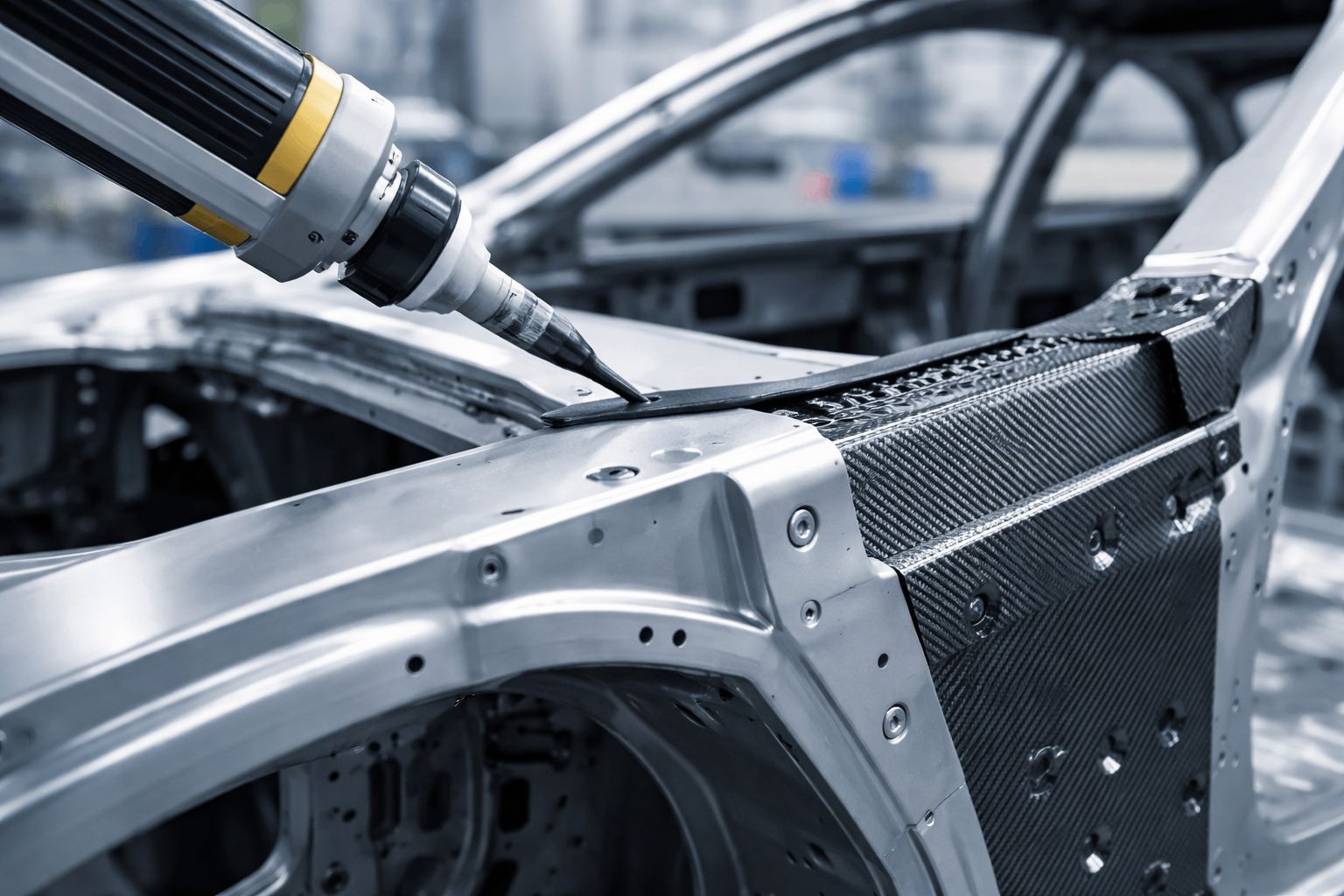
One of the most significant challenges in EV development is weight reduction. Battery systems add substantial mass, and every additional kilogram directly affects driving range, efficiency, and performance.
To offset battery weight, automakers increasingly adopt lightweight materials such as:
Aluminum alloys
High-strength and ultra-high-strength steel
Magnesium components
Fiber-reinforced composites
These dissimilar materials are often difficult—or impossible—to join effectively using traditional welding methods. Automotive body adhesives, by contrast, offer excellent compatibility across mixed substrates.
Compared to bolts or rivets, adhesives provide several advantages in lightweight EV design:
Elimination of drilling, preserving material integrity
Reduced stress concentration
Lower overall component weight
Improved fatigue resistance
As EV manufacturers push the limits of lightweight construction, adhesives become not just an option but a necessity.
Safety remains a top priority in electric vehicle design, particularly given the presence of high-voltage battery systems.
Automotive body adhesives contribute to enhanced crash performance by:
Distributing impact forces across bonded areas
Preventing crack propagation
Improving joint stiffness without adding weight
In EVs, where battery protection is critical, adhesives help maintain structural integrity during frontal, side, and rear impacts.
Adhesives are widely used to seal battery enclosures against:
Moisture ingress
Dust and debris
Chemical exposure
This sealing function is essential for maintaining battery performance, safety, and lifespan, further increasing adhesive usage per vehicle.
Electric vehicles are significantly quieter than traditional vehicles, which changes how drivers perceive sound and vibration.
Without engine noise to mask minor sounds, EV occupants are more sensitive to:
Road noise
Wind noise
Body panel vibrations
Automotive body adhesives offer inherent damping properties that help reduce vibration transmission between components.
Compared to rigid mechanical joints, adhesive bonds:
Absorb micro-vibrations
Reduce squeaks and rattles
Improve overall cabin comfort
As consumer expectations for EV refinement rise, manufacturers increasingly rely on adhesives to meet stringent NVH targets.
Thermal management is a critical aspect of EV performance, particularly for batteries, power electronics, and electric motors.
Battery packs generate heat during charging and discharging cycles. Automotive adhesives are used in:
Bonding cooling plates
Securing thermal interface materials
Encapsulating sensitive components
Advanced adhesive formulations can maintain bonding strength across wide temperature ranges while supporting heat dissipation.
EV components experience frequent temperature fluctuations. Adhesives designed for automotive body applications must withstand:
Expansion and contraction of dissimilar materials
Long-term exposure to elevated temperatures
Repeated thermal cycling without degradation
These performance requirements drive demand for high-quality, specialized adhesive solutions.
The transition to electric vehicles is also reshaping automotive manufacturing processes.
Automotive body adhesives enable:
Fewer parts and fasteners
Cleaner assembly lines
Reduced need for complex welding operations
This simplification is especially valuable for EV startups and manufacturers adopting new production models.
Modern adhesive systems are designed for:
Robotic dispensing
Controlled curing times
Inline quality monitoring
As EV production volumes scale up, adhesives support high-speed, automated assembly while maintaining consistent quality.
Sustainability is a central theme in the electric vehicle ecosystem, extending beyond zero-emission driving to manufacturing practices.
Compared to welding, adhesive bonding typically requires:
Less energy input
Lower process temperatures
Reduced carbon footprint
This aligns well with automakers’ sustainability goals.
Advanced adhesive technologies are evolving to support:
Improved recyclability of bonded structures
Easier separation of materials at end-of-life
Reduced material waste during production
As regulations around vehicle recycling tighten, adhesive innovation continues to play a crucial role.
One of the clearest indicators of EV-driven demand is the growing volume of adhesives used per vehicle.
Compared to conventional vehicles, electric vehicles typically require:
More structural adhesives
More sealing and encapsulation materials
More specialized formulations
Industry studies consistently show that adhesive usage per EV is significantly higher than in ICE vehicles.
As global EV adoption accelerates, this increased per-vehicle consumption translates directly into:
Strong market growth for automotive body adhesives
Greater demand for customized adhesive solutions
Closer collaboration between adhesive suppliers and automakers
The EV transition presents both opportunities and challenges for adhesive producers.
Automotive body adhesives for EVs must meet demanding requirements, including:
High structural strength
Excellent thermal and chemical resistance
Compatibility with multiple substrates
Suppliers that invest in R&D and application engineering are best positioned to succeed.
As adhesives become integral to EV design, manufacturers increasingly involve adhesive suppliers early in the development process. This collaboration enables:
Optimized bonding solutions
Faster product development cycles
Improved overall vehicle performance
Electric vehicles are not merely changing how cars are powered—they are reshaping how vehicles are designed, built, and assembled. In this transformation, automotive body adhesives have emerged as a critical enabling technology.
From lightweight multi-material structures and battery integration to NVH control and sustainable manufacturing, adhesives address many of the unique challenges posed by electric vehicles. As EV adoption continues to accelerate worldwide, the demand for high-performance automotive body adhesives will only grow stronger.
For automakers, adhesives offer design flexibility, efficiency, and performance advantages that align perfectly with the future of mobility. For adhesive suppliers, the EV revolution represents a powerful driver of innovation, collaboration, and long-term market growth.


 Language
 Email
Email WhatsApp